
Speak freely.
Score confidently.
A full 11-minute IELTS Speaking simulation with an AI examiner — all 3 parts, real follow-up questions, and an instant band score on every criterion.
- ✓Full Part 1 → 2 → 3 flow, just like the real interview
- ✓AI examiner asks natural follow-up questions
- ✓Speak into your mic — AI transcribes and responds in real time
- ✓Band score for Fluency, Vocabulary, Grammar, and Pronunciation
A real examiner.
In your browser.
Live conversation, cue card support, and instant feedback — all in one session.
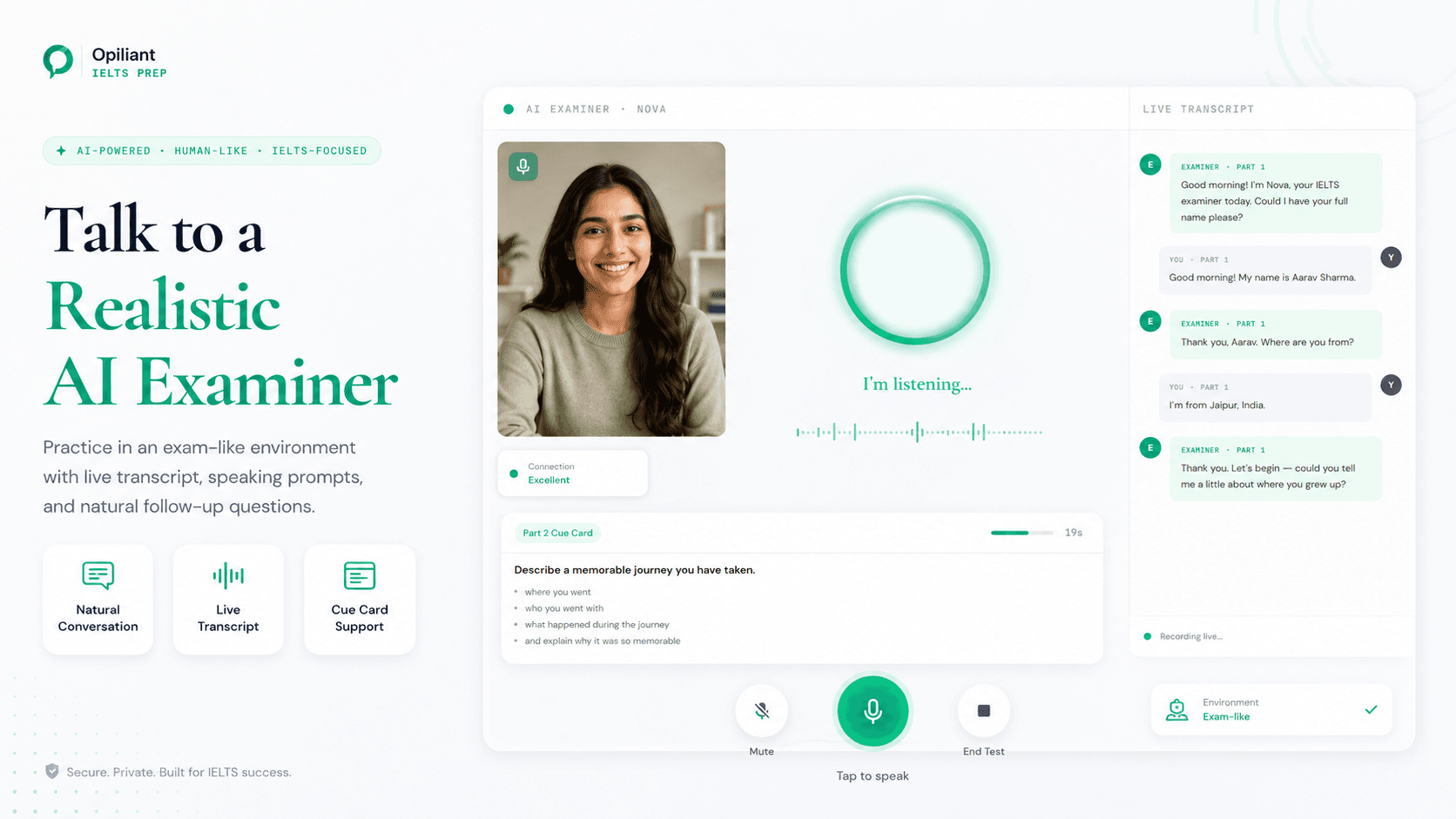
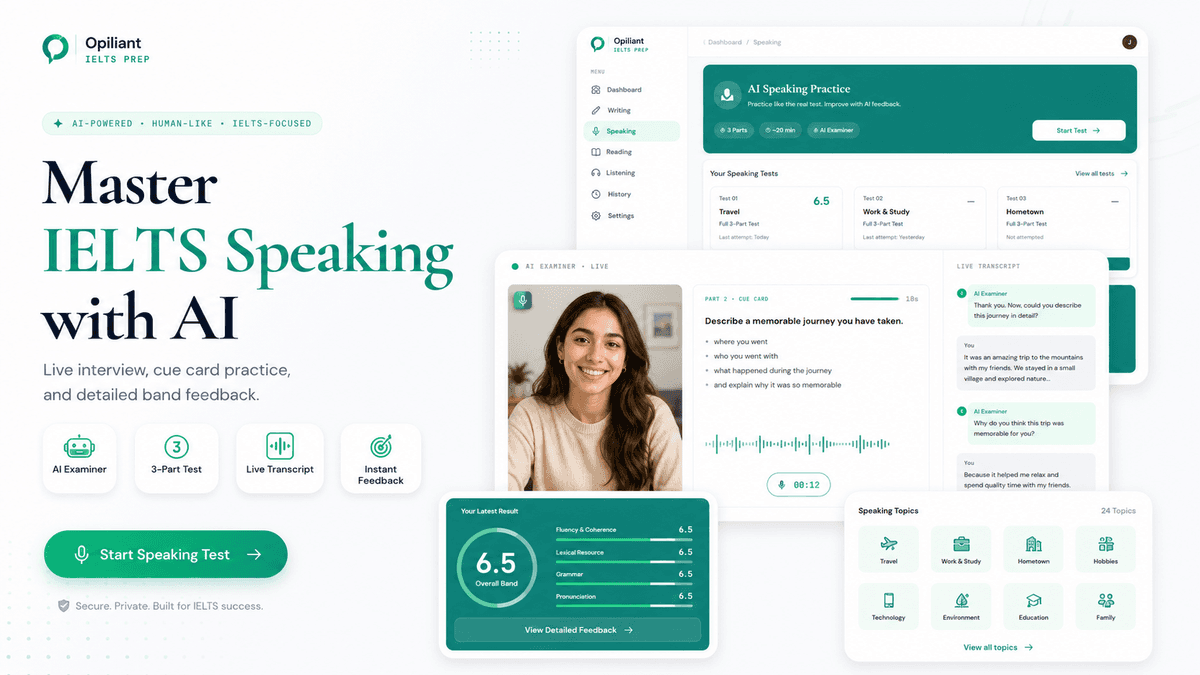
Select a topic and see the complete 3-part flow
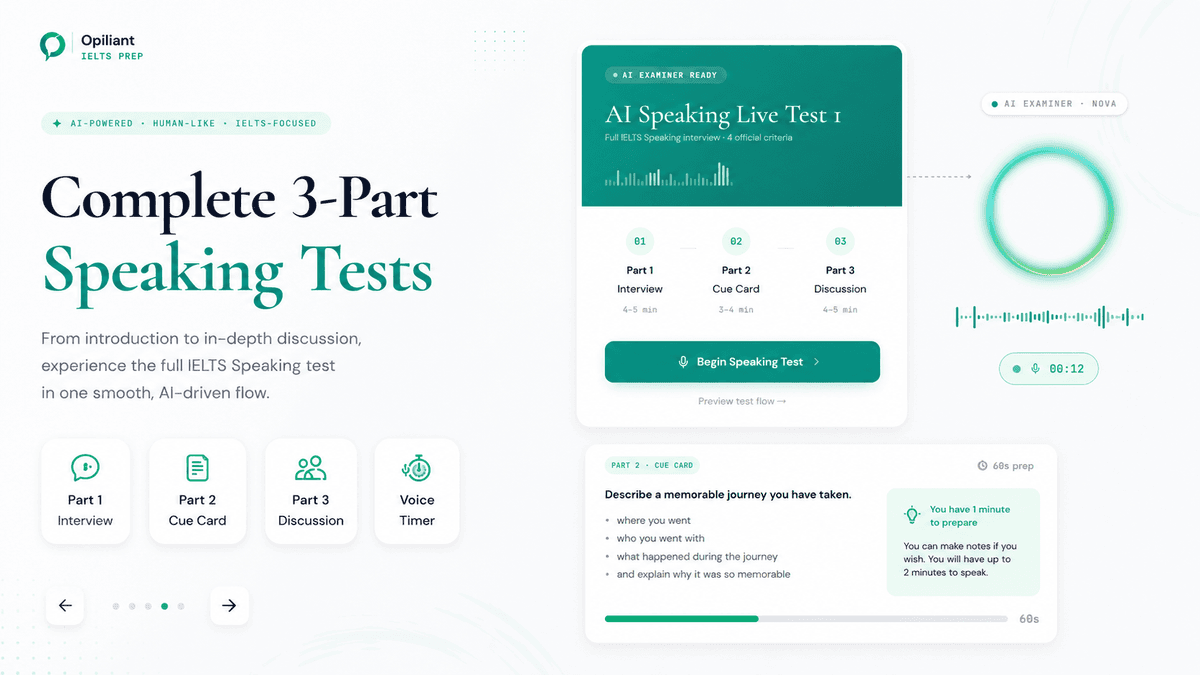
Part 1 → Cue Card → Discussion in one session
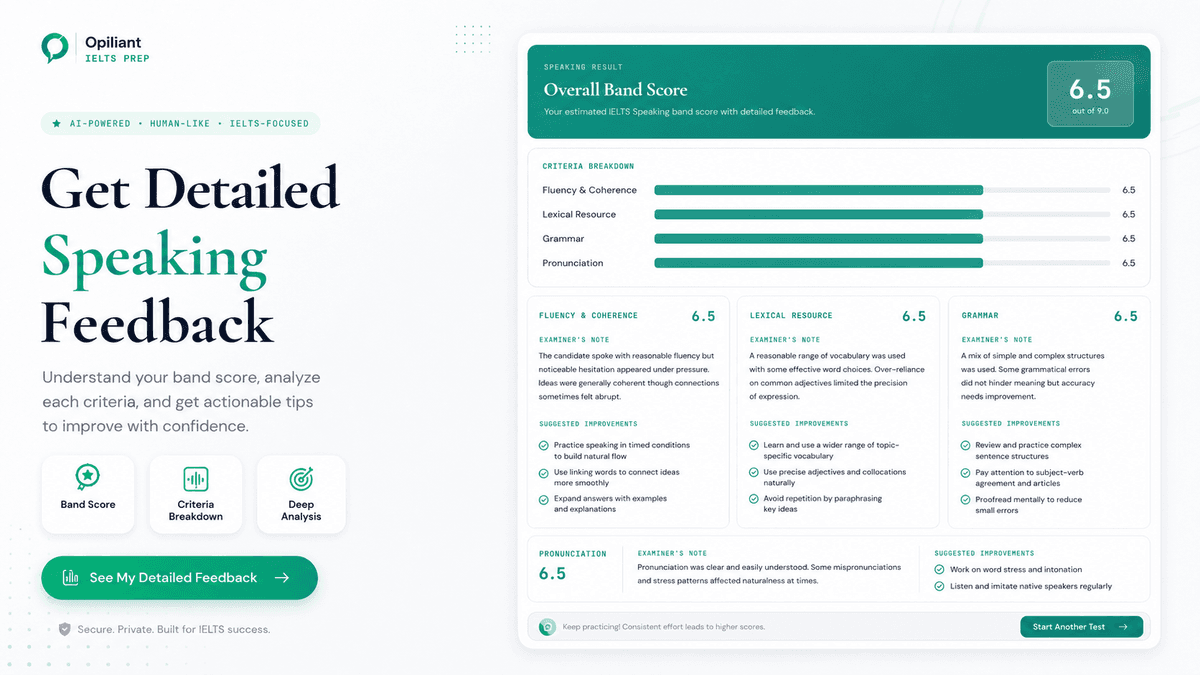
Band score on all 4 IELTS speaking criteria
Three parts. One interview.
Each part tests a different speaking skill — from everyday chat to abstract discussion.
Part 1 · Introduction
4–5 minutes of familiar questions about yourself — home, family, work, hobbies, and everyday topics. The examiner listens and follows up naturally.
Part 2 · Long Turn
You speak for 1–2 minutes on a cue card topic. You have one minute to prepare notes. The AI examiner waits, then asks a brief follow-up.
Part 3 · Discussion
4–5 minutes of abstract, two-way discussion linked to the Part 2 topic. More complex ideas, opinions, and hypotheticals — the hardest part.
Strategy for some criteria
Your Speaking band is the average of these four — each one counts equally.
Fluency & Coherence
Can you speak at length without unnatural hesitation? Are your ideas logically connected and easy to follow?
- ✓Hesitation fillers like 'um' and 'uh' lower your score — replace with a pause
- ✓Link ideas with connectives: 'whereas', 'in contrast', 'what's more'
- ✓Develop each answer with an example or personal experience
- ✓Don't memorise scripts — examiners detect rehearsed responses
Lexical Resource
Do you use a wide range of vocabulary with precision? Can you paraphrase when you don't know an exact word?
- ✓Use topic-specific vocabulary naturally — not just general words
- ✓Paraphrase rather than repeat: 'it means…', 'in other words…'
- ✓Collocations matter: 'make a decision', not 'do a decision'
- ✓Use idiomatic expressions where natural — but don't force them
Grammatical Range
Do you use a variety of grammatical structures accurately? A mix of tenses, conditionals, and complex sentences raises your band.
- ✓Use a range of tenses — past, present perfect, conditionals
- ✓If/when clauses show range: 'If I had more time, I would…'
- ✓Self-correction is fine — it shows awareness, not weakness
- ✓Minor errors don't hurt much — frequency of errors does
Pronunciation
Is your speech easy to understand? You're not judged on accent — only on clarity, word stress, and intonation.
- ✓Stress the right syllable: 'pho-TOgraph' not 'PHO-to-graph'
- ✓Rising intonation signals a question — use it accurately
- ✓Chunk your speech into natural phrases with brief pauses
- ✓Clear vowel sounds matter more than a 'native' accent
How it works
Choose a topic
Pick from curated IELTS topics — each one covers all 3 parts of the Speaking test.
Talk to the AI examiner
Speak naturally into your microphone. The AI listens, transcribes, and responds just like a real examiner.
Get your band score
All 4 criteria scored instantly after the session, with detailed feedback on what to improve.
Ready to face the examiner?
Free to use. Subscribe to unlock Pro features.